
The hidden cost of electrification: is your logistics property ready for the multi-tenant energy crunch?
For logistics property builders, developers and asset managers in Singapore, the playbook for a modern warehouse used to be straightforward: install rooftop solar, put in a few EV chargers for the fleet, and run a building energy management system. As heavy-duty EV trucks come online and multi-tenant operations intensify, a fragmented approach to energy assets is quietly eroding bottom lines.
Three hidden costs of fragmented energy
When solar, battery storage (BESS), building loads and EV fleets are managed as separate silos, industrial properties face three predictable operational headaches:
- · Unmanaged peak-demand charges. Simultaneous charging spikes from EV fleets push building electricity bills into the highest tariff brackets — for loads that could otherwise be shifted by minutes or smoothed by storage.
- · Underutilised solar harvest. Clean afternoon energy is wasted because it cannot be intelligently directed to the loads that would use it, when they would use it. Export back to the grid is rarely the highest-value path.
- · The substation wall. When tenants demand more power for advanced manufacturing or heavy-fleet charging, property owners hit a hard local-grid limit — triggering slow, multi-million-dollar physical grid upgrades and protracted SP Group engagement.
From "building management" to Industrial Energy Hubs
The market doesn't lack hardware. It lacks ecosystem coordination. If you optimise solar in a vacuum, or let EV charging run without visibility into the warehouse's real-time load, you leave money on the table and risk infrastructure strain.
To future-proof logistics real estate, the shift is from treating warehouses as static properties to running them as integrated Industrial Energy Hubs: solar, BESS, smart EMS and EV charging wrapped into a single, unified operational layer. The asset-level outcomes:
- · Lower peak demand — power spikes are shaved automatically by storage and load scheduling.
- · Lower overall energy costs — on-site solar is matched to on-site demand, maximising self-consumption and the financial return of the rooftop asset.
- · Improved asset resilience — the property absorbs local grid constraints without immediate, disruptive capital expenditure on hardware upgrades.
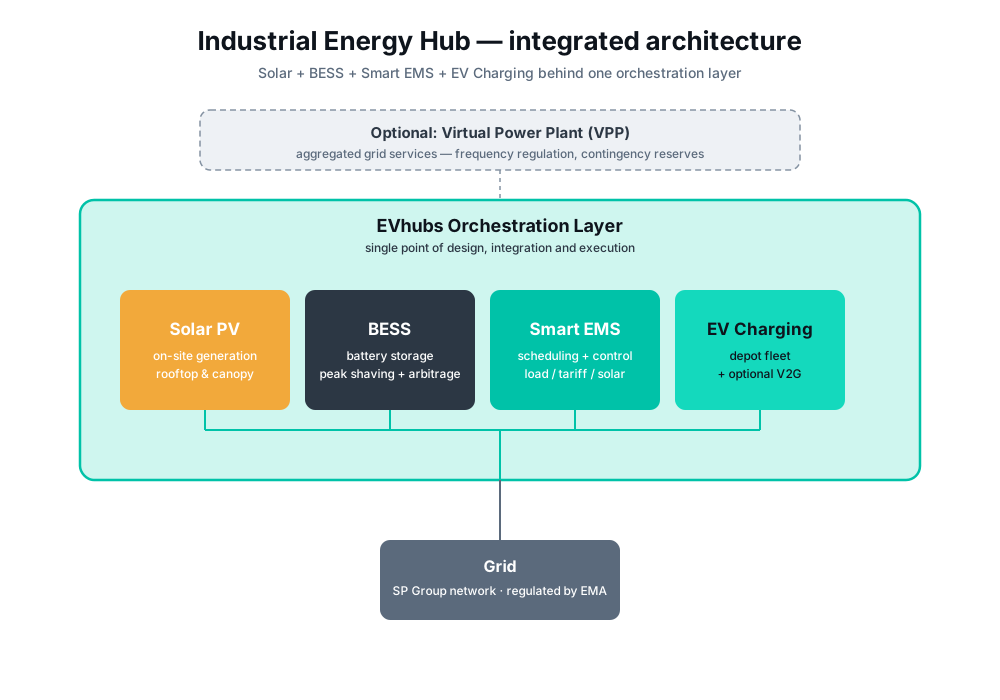
Where this fits: V2G and Virtual Power Plants
Two adjacent concepts come up in the same conversation, and it's worth being precise about where the Industrial Energy Hub framing sits relative to them.
Vehicle-to-Grid (V2G)
V2G is bidirectional charging. The same EV charger that puts energy into the vehicle can, under software control, pull energy back out — turning the parked fleet into distributed storage. A V2G setup needs three things: a V2G-capable vehicle, a bidirectional charger, and an EMS that can schedule the flows. The vehicle charges when energy is cheap or solar is abundant, and exports back later when the grid (or the site) needs it.
For an industrial property with a sizeable fleet, V2G means the fleet is no longer just a load — it becomes a controllable storage asset for the site's energy stack. V2G-capable hardware is still a small share of the fleet market in 2026, and standards work is evolving, but for fleets with predictable depot dwell times the future-addressable value is meaningful.
Virtual Power Plants (VPPs)
A VPP is not a physical power station. It's a software layer that aggregates many small distributed energy resources — rooftop solar, batteries, EV chargers, controllable loads — and operates them as if they were one larger generation asset. The Energy Market Authority describes a VPP as a network of decentralised, distributed energy resources aggregated and managed like a conventional large power-generation plant — and can register as a single generator in the Singapore Wholesale Electricity Market.
SP Group has operated VPP capability for grid services such as frequency regulation and contingency reserves, with reported integrated capacity in the megawatt range — concrete evidence that VPPs are treated as real grid infrastructure in Singapore, not just a theoretical layer.
Industrial Energy Hub vs VPP — the distinction
A VPP is primarily about aggregating assets across owners to provide grid services, a market-facing layer. An Industrial Energy Hub is primarily about orchestrating a single site (or estate) to create virtual grid capacity for that site's own demand. The two are complementary:
- · The Energy Hub is the site-level architecture — solar + BESS + smart EMS + (potentially V2G-capable) EV charging — that turns the property's own consumption pattern from a problem into a resource.
- · The VPP is the market-side layer that lets a portfolio of such sites (or aggregated assets across sites) participate in the wholesale market, frequency regulation, or contingency-reserve services for additional value.
Built well, an Industrial Energy Hub can plug into a VPP — but it stands on its own value (cost, resilience, growth headroom) without market participation.
Looking for forward-thinking property partners
EVhubs approaches this from an infrastructure-asset perspective — with engineering experience across Singapore's regulatory environment and international clean-energy projects. Singapore's logistics and industrial estates are facing immediate electrical-capacity pressures, and the best way to demonstrate the engineering case is to prove the dollars and cents in the real world.
We are currently looking to partner with a logistics property builder, developer, or industrial fleet operator to launch a focused Demonstration Project in Singapore — a replicable, high-efficiency model for industrial infrastructure across ASEAN.
If you are a property leader or asset owner currently managing a multi-tenant industrial site, a logistics warehouse, or a commercial fleet depot, and you want to lower operational energy costs while future-proofing the facility against power constraints, we'd like to talk.
Discuss a Demonstration Project Explore Charging-as-a-Service Talk to an Advisor
Sources & methodology: VPP framing references the Energy Market Authority's published positioning on distributed energy resources and aggregated market participation. SP Group's VPP work is cited from SP Group's public communications on grid-services capability. V2G technical structure aligns with bidirectional-charging standards work tracked by CharIN and reflected in Singapore's evolving EV charging standard (TR25:2022 → SS 722; see our companion piece on SS 722). Specific tariff structures, market-participation eligibility, capacity figures, and SP Group's published VPP numbers are time-sensitive and should be verified directly with EMA and SP Group before they inform investment decisions. This article is a strategic framing piece; specific deal terms or engineering specifications are subject to project-level scoping.